Security
Application security
From an application point of view, MyTower manages application security on three aspects: Web security (verified with penetration tests), authentication security (SSO, password management) and source code security (verified by static source code analysis)
Web security
Our solutions are checked against the most common risks and vulnerabilities, as recommended by OWASP.
Our Cybersecurity Department conducts periodic penetration tests and verifies, among other things:
-
SQL injection attacks
-
Cross Site scripting (XSS)
-
Authentication attacks
-
Authorization attacks
-
Customer-side attacks
-
Information disclosure attacks
-
Logical attacks
-
JavaScript and ajax attacks
-
Denial of Service
-
Brute force attacks
-
Abusive file download
The services exposed by the MyTower apps are all encrypted in transit with TLS 1.3 (HTTPS and SFTP).
Authentication security
For authentication security, the MyTower recommendation is to delegate authentication to the customer's SSO systems (see Single Sign-On below).
In the event that the customer does not wish to use the SSO, a MyTower password management policy applies. This policy is available on request.
Source code security
MyTower uses SonarQube to perform code security scans at each commit. Sonar's remarks block the merge of the commits, so a correction of these remarks is necessary before the merge of the code in question is done.
Infrastructure security
The following security measures are applied to the infrastructure:
-
Access
-
Isolation of infrastructure (masters and workers) in private network (VPC, see paragraph on infrastructure).
-
Access only to the Kubernetes master API. Named access for authorized persons only. This is the access that allows application deployment.
-
-
Hardening
-
SSH access is not authorized to the masters and workers from the WAN network
-
The only flows allowed on the workers are the flows needed for the operation of kubernetes.
-
-
OS:
-
SECURITY at the OS level is managed by the Scaleway. All OS patches are managed by the host.
-
Antivirus: BitDefender antivirus is installed on different nodes and managed by the hosting provider.
-
Single Sign-On (SSO)
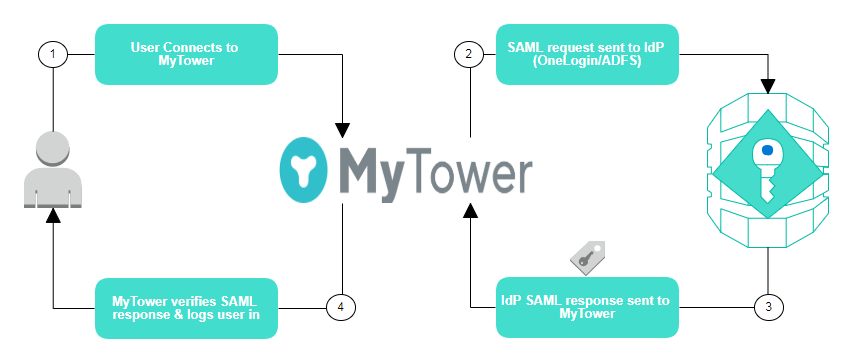
MyTower supports connectivity on customers' SSO systems. This connectivity will allow:
-
Automatic user creation in MyTower
-
Authentication of customer users in MyTower using their credentials in customer systems.
-
Delegate authentication security to the Customer: complexity/periodicity of passwords, multi-factor authentication, etc.
This connectivity can be either via SAML2 (Security Assertion Mark-up Language) or OIDC (OpenID Connect). MyTower supports both modes.
The customer takes the role of an SSO (Identity Provider or IdP) provider and MyTower the role of a Service Provider (SP).